

Does Cyber Insurance Cover AI? The Definitive Answer for Australian Businesses
A comprehensive guide to understanding how insurance responds to artificial intelligence risks in 2026
As artificial intelligence becomes integral to Australian business operations, from customer service chatbots to automated data analysis, business owners are asking a critical question: does cyber insurance actually cover AI-related incidents? The answer isn’t as straightforward as many assume, and understanding the nuances could be the difference between comprehensive protection and devastating financial exposure.
With AI adoption accelerating across every industry, the intersection between artificial intelligence and insurance coverage has become one of the most important risk management considerations facing modern businesses. Whether you’re using ChatGPT for content creation, AI-powered accounting software, or sophisticated machine learning algorithms, the potential for AI-related incidents creates new exposures that many business owners don’t fully understand.
This guide provides the definitive answer to AI coverage questions, explains how different insurance policies respond to various AI incidents, and reveals why a comprehensive review of your current coverage may be more urgent than you realise.
Understanding AI in Modern Business Operations
Artificial intelligence has evolved from experimental technology to essential business infrastructure across Australian enterprises. Today’s AI applications span virtually every business function, from customer interactions and data processing to decision-making and content generation.
Common Business AI Applications: Customer service chatbots handling sensitive customer enquiries and payment information. Automated data analysis processing confidential business and client information. Content generation tools creating marketing materials, emails, and client communications. Predictive analytics influencing business decisions and strategic planning. Document processing systems handling contracts, invoices, and legal documents.
The Risk Reality: Each AI application creates potential exposure points that traditional insurance policies weren’t originally designed to address. When businesses integrate AI tools into operations involving sensitive data, client services, or decision-making processes, they create new pathways for cyber incidents, professional liability claims, and privacy breaches.
The critical insight many business owners miss is that AI doesn’t operate in isolation. These tools interact with business systems, process confidential information, and influence decisions that can have significant financial consequences. Understanding how insurance responds to AI-related incidents requires recognising that AI amplifies existing business risks rather than creating entirely new categories of exposure.
Common AI-Related Risks Facing Australian Businesses
The landscape of AI-related business risks continues expanding as adoption increases and threat actors adapt their tactics to exploit AI vulnerabilities. Industry insights reveal several key risk categories that Australian businesses commonly encounter.
Data and Privacy Exposures
Inadvertent Data Disclosure: Employees uploading confidential client information to public AI platforms like ChatGPT or Claude for analysis or processing. Financial data, legal documents, and customer information accidentally shared with third-party AI providers. Client confidentiality breached through AI-generated outputs that inadvertently reveal sensitive information.
Example Scenario: A Melbourne accounting firm’s staff member uploads client financial statements to an AI tool for analysis, not realising the platform retains and potentially uses this data for model training. When clients discover their confidential information was shared with a third-party AI provider without consent, privacy liability and professional liability claims arise.
Cross-Contamination Risks: AI tools trained on multiple users’ data potentially exposing one client’s information in responses to other users’ queries. Business confidential information appearing in AI outputs when processing similar requests from competitors or third parties.
Professional and Advisory Liability
AI-Generated Errors: Professional services firms relying on AI-generated analysis, recommendations, or content that contains material errors affecting client outcomes. Legal practices using AI for contract analysis or legal research that produces incorrect or incomplete results. Financial advisory services incorporating AI-generated market analysis or investment recommendations that prove inaccurate.
Example Scenario: A Sydney law firm uses AI to review commercial contracts for a major client acquisition. The AI tool misses critical liability clauses, resulting in the client facing unexpected legal exposure worth $2.3 million. The client pursues professional liability claims against the law firm for inadequate legal review.
Decision-Making Liability: Business leaders making strategic decisions based on flawed AI analysis or recommendations. Professional advisors incorporating AI insights into client advice without adequate human oversight or verification.
Cyber Crime and Fraud Exposures
AI-Enhanced Social Engineering: Criminals using AI to create convincing deepfake audio or video for CEO fraud and business email compromise attacks. Sophisticated phishing campaigns using AI to personalise attack content and bypass traditional security awareness training.
Example Scenario: A Perth manufacturing company receives what appears to be urgent video call instructions from their CEO to transfer $180,000 to a new supplier account. The “CEO” is actually a sophisticated AI-generated deepfake, but the finance team, convinced by the realistic audio and video, processes the fraudulent payment.
AI-Powered Attack Escalation: Threat actors using AI tools to identify vulnerabilities in business systems more efficiently. Automated social engineering attacks targeting employees through AI-generated content designed to appear legitimate and urgent.
Operational and Technology Failures
System Integration Failures: AI tools making autonomous decisions that disrupt business operations or damage client relationships. Automated systems processing incorrect data or executing flawed business logic with significant financial impact.
AI Model Malfunctions: Machine learning algorithms producing biased or discriminatory outputs that result in regulatory violations or discrimination claims. AI systems making decisions that violate industry regulations or professional standards.
How Insurance Policies Respond to AI Incidents
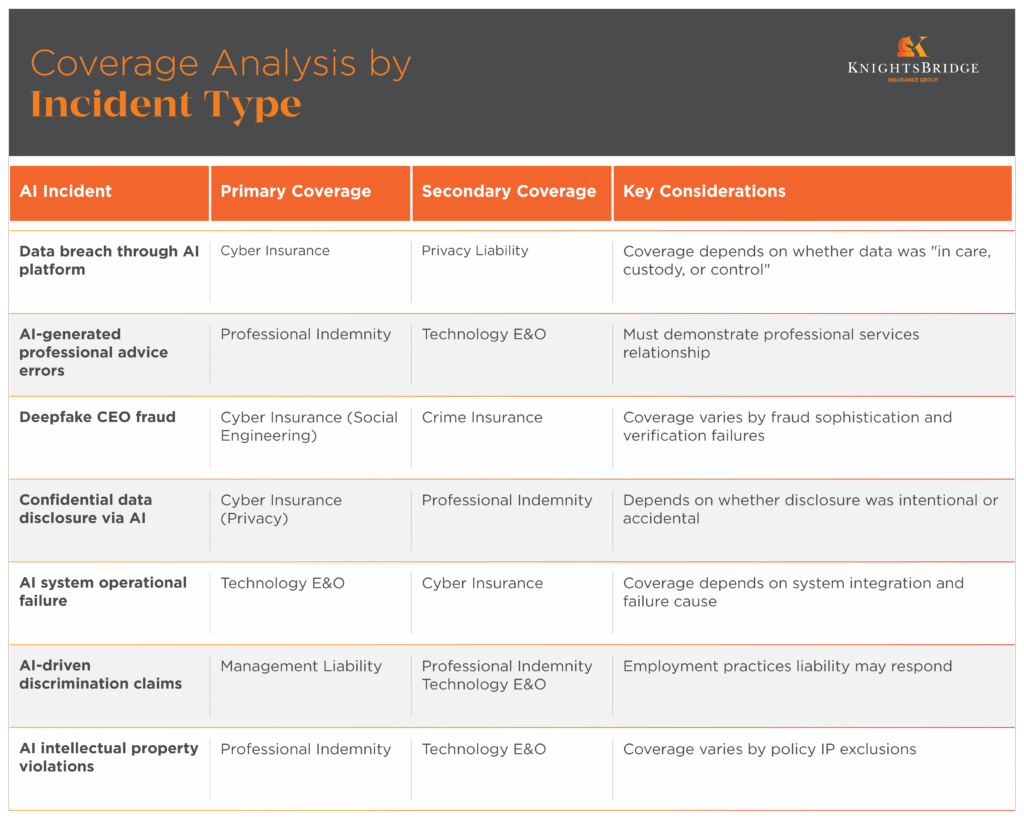
Understanding AI insurance coverage requires recognising that AI-related incidents typically trigger existing insurance policies rather than specialised “AI insurance” products. The key is identifying which policy responds based on the nature of the incident and resulting loss.
Cyber Insurance and AI Incidents
Modern cyber insurance policies increasingly include AI-affirmative language that clarifies coverage intentions around artificial intelligence use. Industry insights indicate that leading insurers are moving away from AI exclusions toward explicit coverage confirmation.
Typical Cyber Insurance Coverage for AI Incidents: Privacy breach response costs when AI tools inadvertently expose personal or confidential information. Business interruption losses resulting from AI system failures or cyber attacks targeting AI infrastructure. Social engineering coverage for AI-enhanced fraud attempts including deepfake scams. Data recovery and forensic investigation costs following AI-related security incidents.
Coverage Considerations: The use of AI tools in business operations does not typically void cyber insurance coverage, provided the underlying incident falls within policy terms. Coverage assessment focuses on the nature of the cyber event rather than whether AI technology was involved. Most leading cyber insurers explicitly state that AI use does not create coverage exclusions or gaps.
Professional Indemnity and AI Services
Professional indemnity insurance becomes critical when businesses provide AI-enhanced services to clients or rely on AI tools for professional decision-making.
Coverage Scenarios: Errors in AI-generated analysis, advice, or recommendations provided to clients. Professional negligence claims arising from inadequate oversight of AI-generated work. Liability for AI-enhanced professional services that fail to meet industry standards.
Coverage Limitations: Some professional indemnity policies may exclude pure technology failures unless connected to professional services. Coverage may require demonstration of professional relationship and reliance on professional expertise.
Crime Insurance and AI-Enhanced Fraud
Crime insurance policies are adapting to address AI-enhanced fraud techniques that bypass traditional verification methods.
Emerging Coverage Areas: Social engineering fraud using AI-generated communications that convince employees to transfer funds or disclose credentials. Forgery coverage may extend to AI-generated documents or communications used in fraudulent schemes. Computer fraud coverage for losses resulting from AI-powered cyber attacks.
Coverage Challenges: Traditional crime policies may struggle with AI-enhanced fraud that exploits human psychology rather than technical vulnerabilities. Coverage may depend on whether businesses maintained reasonable verification procedures despite sophisticated AI deception.
Coverage Gaps and Insurer Variations
While the insurance industry increasingly embraces AI-affirmative coverage approaches, significant variations exist between insurers in how they assess and respond to AI-related claims.
Policy Language Differences
AI-Affirmative Insurers: Leading insurers explicitly include policy language confirming that AI use does not void coverage or create additional exclusions. These policies focus on underlying causes of loss rather than technologies involved. Clear statements that AI-related incidents receive the same coverage assessment as traditional cyber events.
Traditional Approach Insurers: Some insurers maintain older policy language that may create ambiguity around AI incident coverage. Policies may lack explicit AI guidance, forcing case-by-case coverage determinations. Potential for coverage disputes when AI involvement complicates traditional incident categorisation.
Underwriting and Assessment Variations
Advanced AI Understanding: Insurers with sophisticated cyber risk teams understand AI integration complexities and assess exposures accordingly. These providers offer guidance on AI risk management and security best practices. Claims assessment considers AI context without prejudice against technology adoption.
Limited AI Expertise: Insurers without specialised AI knowledge may struggle to assess AI-related claims appropriately. Coverage decisions may reflect limited understanding of AI business applications and risk characteristics. Potential for conservative coverage interpretations when AI involvement creates assessment complexity.
Industry-Specific Considerations
Professional Services: Law firms, accounting practices, and consultancies face enhanced professional liability exposures when incorporating AI into client services. Coverage adequacy depends on policy recognition of evolving professional service delivery methods.
Technology Companies: Software developers and technology service providers require policies that address AI-enhanced products and services. Coverage must accommodate rapid AI development cycles and emerging application areas.
Financial Services: Banks, credit unions, and financial advisors using AI for client services or investment decisions need comprehensive coverage for regulatory violations and professional liability claims.
Why AI Coverage Review is Essential
The rapidly evolving AI landscape creates ongoing coverage assessment challenges that require proactive attention rather than reactive responses following incidents.
Emerging Risk Factors
Regulatory Evolution: Australian privacy and consumer protection regulations continue adapting to address AI-specific risks and requirements. New compliance obligations may create coverage gaps if policies don’t address evolving regulatory landscapes.
Technology Integration Complexity: AI tools integrate with existing business systems in ways that may create unexpected coverage interactions or gaps. Multi-vendor technology stacks incorporating AI may complicate coverage determination and claims coordination.
Business Adoption Acceleration
Expanding AI Use Cases: Businesses continuously adopt new AI applications that may create exposures not contemplated during last insurance renewal. Employee AI tool adoption often outpaces formal risk assessment and insurance review processes.
Third-Party AI Dependencies: Increased reliance on third-party AI platforms creates coverage questions around vendor failures, service interruptions, and data handling incidents.
Claims Complexity
Multi-Policy Coordination: AI-related incidents often involve multiple insurance policies, creating coordination complexity and potential coverage gaps between different insurers. Professional claims management becomes essential for optimising coverage outcomes across different policy types.
Evidence and Documentation: AI incident claims require sophisticated documentation and analysis to establish causation and coverage relationships. Traditional claims processes may need adaptation to address AI-specific evidence and expert testimony requirements.
Insurer Selection and Policy Optimisation
Not all cyber insurance providers approach AI risks with equal expertise or coverage flexibility, making insurer selection increasingly important for businesses using AI tools.
Evaluation Criteria for AI-Savvy Insurers
Policy Language Assessment: Review policy wording for explicit AI-affirmative language that confirms coverage intentions. Evaluate exclusion language to ensure AI use doesn’t create unintended coverage voids. Assess whether policy definitions accommodate AI applications relevant to your business operations.
Claims Capability: Understand insurer experience with AI-related claims and their approach to coverage assessment. Evaluate access to specialist AI risk experts and claims support resources. Review insurer track record for fair and efficient AI incident claims resolution.
Risk Management Support: Assess whether insurers provide AI risk assessment and management guidance. Evaluate availability of AI-specific security recommendations and best practice resources. Consider insurers who understand AI integration challenges and provide proactive risk management support.
Policy Structure Optimisation
Coverage Coordination: Ensure cyber insurance coordinates effectively with professional indemnity, technology errors and omissions, and crime insurance policies. Identify potential coverage gaps between different policy types and address through policy endorsements or additional coverage.
Limit Adequacy: Assess whether coverage limits reflect realistic AI incident costs including business interruption, privacy breach response, and professional liability claims. Consider whether sub-limits for specific coverage areas adequately address AI-related exposure concentrations.
Australian Regulatory Considerations
Australian businesses using AI tools operate within evolving regulatory frameworks that create specific insurance considerations and compliance requirements.
Privacy Act Implications
Data Handling Obligations: AI platforms processing personal information must comply with Privacy Act requirements for data collection, use, and disclosure. Breach notification obligations apply to AI-related privacy incidents, creating cyber insurance claim triggers.
Cross-Border Data Transfers: AI platforms operated by international providers may transfer Australian personal information overseas, creating additional Privacy Act compliance obligations and potential cyber insurance considerations.
Professional Standards and AI
Industry-Specific Requirements: Professional services industries maintain specific standards for AI use in client services that may affect professional indemnity coverage. Legal, accounting, and financial advisory professions face particular regulatory scrutiny around AI-enhanced professional services.
Quality Assurance Obligations: Professional standards often require adequate supervision and quality control over AI-generated work, with professional indemnity implications for inadequate oversight.
Practical Steps for AI Risk Assessment
Business owners using AI tools should implement systematic approaches to understand their insurance coverage adequacy and identify potential gaps.
Current Coverage Review
Policy Analysis: Review existing cyber insurance, professional indemnity, and crime insurance policies for AI-related language and coverage confirmation. Identify any exclusions or limitations that might affect AI incident coverage. Assess coverage limits and deductibles in context of realistic AI incident costs.
Insurer Engagement: Contact current insurers to clarify their approach to AI incident coverage and claims assessment. Request written confirmation of coverage intentions for specific AI applications used in your business. Understand insurer requirements for AI risk management and security practices.
AI Use Inventory
Business Application Assessment: Document all AI tools and platforms used across business operations including employee-initiated usage. Identify data types and sensitivity levels processed through AI applications. Assess integration points between AI tools and existing business systems.
Risk Exposure Mapping: Evaluate potential incident scenarios for each AI application and likely insurance coverage responses. Consider cascading effects of AI failures on business operations and client relationships.
Professional Guidance
Insurance Broker Consultation: Work with qualified insurance professionals who understand AI risk landscapes and coverage developments. Access specialist knowledge about insurers with AI expertise and appropriate coverage approaches. Benefit from professional advocacy during coverage reviews and claims situations.
Legal and Compliance Review: Engage legal professionals experienced in AI regulatory compliance and professional liability considerations. Ensure AI use policies and procedures meet industry standards and regulatory requirements.
Looking Forward: AI Coverage Evolution
The insurance industry’s approach to AI continues evolving as adoption increases and claims experience develops, making ongoing coverage review essential rather than optional.
Market Development Trends
Coverage Expansion: Leading insurers continue developing AI-specific coverage enhancements and risk management services. Industry movement toward standardised AI coverage language and claim assessment approaches. Emergence of specialist AI risk insurance products for high-exposure industries and applications.
Risk Assessment Sophistication: Insurers developing advanced AI risk assessment capabilities and underwriting approaches. Integration of AI risk factors into standard cyber insurance underwriting and pricing models. Enhanced claims handling expertise for AI-related incident assessment and resolution.
Strategic Considerations
Proactive Management: Businesses adopting AI tools benefit from proactive insurance review rather than reactive coverage assessment following incidents. Early engagement with AI-savvy insurers and brokers provides access to evolving coverage options and risk management resources.
Competitive Advantage: Comprehensive AI risk management and insurance coverage can provide competitive advantages in client acquisition and business development. Professional AI adoption with appropriate risk management demonstrates sophisticated business practices to clients and partners.
Navigating AI Coverage Complexity
The question of whether cyber insurance covers AI reflects the broader challenge of managing emerging technology risks within traditional insurance frameworks. While leading insurers increasingly embrace AI-affirmative coverage approaches, significant variations exist in policy language, claims handling, and risk assessment capabilities.
The definitive answer is that AI-related incidents are typically covered by existing insurance policies, but coverage adequacy depends on incident type, policy structure, and insurer expertise. Businesses cannot assume coverage automatically extends to all AI applications or that all insurers assess AI risks with equal sophistication.
Every Australian business using AI tools should conduct comprehensive insurance reviews that assess current coverage adequacy, identify potential gaps, and ensure access to insurers with appropriate AI expertise. The cost of coverage uncertainty far exceeds the investment in professional risk assessment and policy optimisation.
The AI revolution in business operations requires an evolution in risk management approaches. Businesses that proactively address AI insurance considerations position themselves for sustainable AI adoption that drives competitive advantage rather than creating unmanaged financial exposure.
Don’t wait for an AI incident to discover coverage gaps or limitations. The time for comprehensive AI risk and insurance review is before you need coverage, not after.
Concerned about your AI insurance coverage? Knightsbridge Insurance Group specialises in comprehensive AI risk assessment and cyber insurance optimisation for Australian businesses. Our expert team understands the evolving AI risk landscape and works with leading insurers who provide AI-affirmative coverage approaches.
Get your AI risk and cyber insurance review:
📞 1300 KBRIDGE (1300 524 743)
📧 [email protected]
🌐 knightsbridgeinsurance.com.au
Don’t leave AI coverage to chance. Work with insurance professionals who understand both AI risks and coverage solutions designed to protect your business.
Important Disclaimer This article provides general information only and does not constitute financial or legal advice. AI insurance requirements and coverage adequacy vary significantly based on individual business operations, AI applications, and risk profiles. Readers should assess their specific AI risks and consult with a licensed insurance professional before making coverage decisions. Knightsbridge Insurance Group holds Australian Financial Services Licence 514855.